
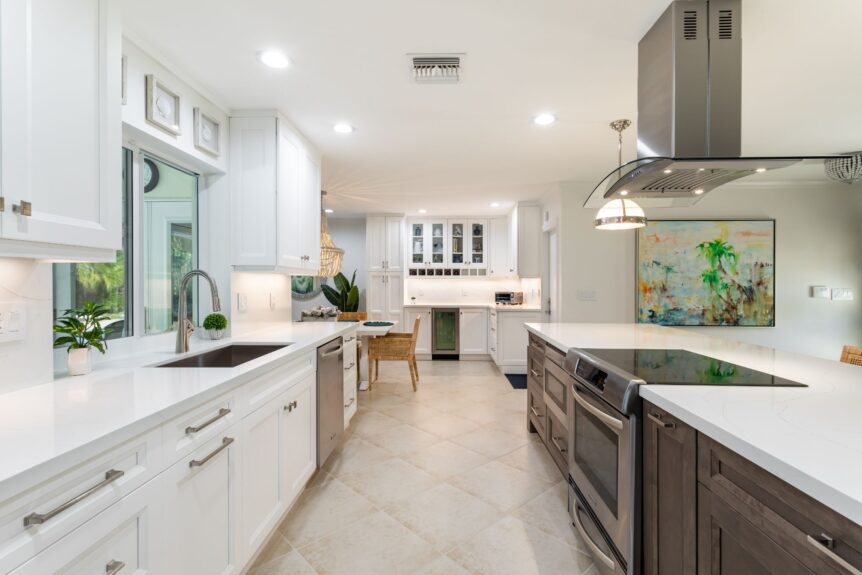
A well-planned kitchen floor plan transforms daily cooking into an efficient, comfortable routine and increases home value—especially in Fort Lauderdale where indoor-outdoor entertaining and coastal lifestyles shape design priorities. This guide explains how core layout principles, practical measurements, and 2025 design trends should influence your choice of kitchen layouts, from compact one-wall solutions to multi-station U-shaped kitchens. Readers will learn the kitchen work triangle basics, a room-by-room comparison of popular layouts with quick-reference tables, actionable zoning and retrofit guidance, and a checklist to match a plan to your lifestyle and budget. Real Fort Lauderdale examples and local considerations are woven through the guidance so homeowners can picture layout trade-offs for entertaining, storage, and multi-cook scenarios. Throughout the article we use precise measurement guidance, lists for decision-making, and tables that compare layout attributes so you can evaluate options and move confidently toward a remodel or consultation.
What Is the Kitchen Work Triangle and Why Is It Essential for Efficient Layouts?
The kitchen work triangle is a foundational design rule that connects three primary work centers—sink, stove, and refrigerator—to minimize wasted movement and streamline cooking tasks. Its mechanism is simple: by reducing the total walking distance between these paramount elements, the triangle enhances workflow efficiency and lowers congestion during meals, which is especially useful for frequent entertainers. The practical benefit is measurable: a properly scaled triangle saves time and keeps sightlines clear, creating a safer and more ergonomic kitchen for single cooks and multiple cooks alike. Understanding the work triangle guides placement decisions across L-shaped, U-shaped, galley, and island configurations and sets hard constraints when planning islands or peninsulas.
This EAV table summarizes ideal distances and quick placement tips to translate the triangle rule into actionable measurements.
| Triangle Leg | Ideal Distance | Practical Tip |
|---|---|---|
| Sink ↔ Stove | 4–9 feet | Place prep counter near sink to reduce transfer steps; avoid situating sink directly next to cooktop without prep space. |
| Stove ↔ Refrigerator | 4–9 feet | Allow landing space near fridge for unloading groceries; avoid fridge blocking main traffic paths. |
| Refrigerator ↔ Sink | 4–9 feet | Keep dishwasher access considerations in mind; ensure clear floor space for door swing and unloading. |
How Does the Kitchen Work Triangle Optimize Appliance Placement?
The triangle optimizes appliance placement by aligning cooking tasks with minimal lateral movement, which improves sightlines and reduces accidental collisions in high-traffic kitchens. For example, placing the refrigerator at one end, the sink centrally, and the cooktop opposite creates predictable paths for food prep and cleanup, reducing cross-flow between cooks. This arrangement is particularly effective in Fort Lauderdale homes where catering to simultaneous prep and social zones matters for entertaining guests. When two cooks work in the same space, staggered workstations that respect the triangle limits help prevent crowding and keep major appliances accessible without blocking walkways. Understanding these mechanics leads naturally to precise clearance and measurement rules that preserve the triangle while accommodating islands, seating, or adjacent living spaces.
What Are the Ideal Measurements for an Effective Work Triangle?
A practical measurement rule for the work triangle is to aim for each leg between 4 and 9 feet, with the triangle perimeter totaling roughly 13 to 26 feet; these distances maintain efficiency without cramped reach or wasted travel. Shorter legs suit compact or galley kitchens where motion economy is vital, while longer legs are acceptable in open-concept or large kitchens where clear circulation paths exist. Exceptions arise when islands interrupt straight lines: in those cases, maintain at least 3 feet of clear walkway around an island and preserve the functional proximity of the three points even if direct sightlines shift. Applying these numbers during an early site measure helps homeowners compare potential layouts against both functional needs and Fort Lauderdale lifestyle factors such as indoor-outdoor flow.
What Are the Most Popular Kitchen Floor Plan Layouts and Their Benefits?
Popular kitchen layouts each solve a different set of challenges—space constraints, storage needs, entertaining, or multiple cooks—and choosing the right one depends on footprint, workflow, and lifestyle. Below is a concise list of the main layouts with snapshot benefits that can serve as a quick featured-snippet style reference when weighing options during a remodel decision.
- L-shaped kitchen layout: Efficient corner use with open sightlines and easy island integration.
- U-shaped kitchen layout: Maximum counter and cabinet space ideal for storage and multi-cook setups.
- Galley kitchen layout: Narrow, highly efficient plan that minimizes motion and suits small footprints.
- Kitchen island layout: Central prep and social hub that supports seating, appliances, and storage.
- Peninsula kitchen: Semi-open solution offering extra counter work without a freestanding island.
- One-wall kitchen: Space-saving single-wall arrangement suited to studios and compact homes.
These short definitions show where each layout fits best and prepare homeowners to explore specifics like clearances, storage strategies, and cost implications. After these layout basics, homeowners can weigh the trade-offs between circulation, appliance placement, and entertaining needs before selecting a plan.
Before the detailed comparisons, here is a quick reference table that helps scan layout suitability against common homeowner attributes.
| Layout Type | Best For (Attribute) | Key Benefits |
|---|---|---|
| L-shaped kitchen layouts | Open-plan living, medium-sized spaces | Clear sightlines to living areas; easy island placement; good for entertaining flow |
| U-shaped kitchen layouts | Storage-focused homes, multi-cook families | Abundant countertops and cabinets; distinct work zones for simultaneous cooks |
| Galley kitchen designs | Narrow footprints, efficiency-first homes | Minimal walking distance; efficient linear workflow; economical cabinetry runs |
| Island configurations | Entertainers, large kitchens | Central prep and social hub; additional storage and seating; flexible appliance placement |
| Peninsula kitchen plans | Semi-open kitchens, limited footprint | Adds counter and barrier without a full island; maintains open-plan separation |
| One-wall kitchen solutions | Studios, budget remodels | Small footprint; compact appliance grouping; simple workflow with added vertical storage |
How Does an L-Shaped Kitchen Layout Maximize Space and Openness?
An L-shaped layout places counters and cabinets along two perpendicular walls, which creates an open corner and preserves sightlines to adjacent living areas—beneficial for entertaining and maintaining a coastal, airy feel in Fort Lauderdale homes. This layout mechanism supports adding an island without breaking the work triangle, provided you maintain at least 3 to 4 feet of clearance around the island for circulation. Storage solutions for corner cabinets, like pull-out carousels or blind-corner organizers, maximize cabinet components while keeping counters clear for prep. For families that host, the L-shape allows social interaction without sacrificing workflow, and careful island sizing ensures seating and prep zones coexist comfortably.
Why Choose a U-Shaped Kitchen Layout for Storage and Multiple Cooks?
A U-shaped layout wraps counters and storage on three sides to create abundant work surface and cabinetry, which directly benefits households with multiple cooks or high storage needs. Its mechanism emphasizes zoning—cleanup, prep, and cooking areas are easily partitioned—so two cooks can work parallel or perpendicular without crossing paths. Critical clearance rules include keeping 42 to 48 inches of walkway in the primary work aisle to prevent congestion between cabinets and island or peninsula elements. U-shapes can also convert one arm into a peninsula for semi-open kitchens, providing seating and service space while preserving extensive storage and countertop real estate.
What Makes the Galley Kitchen Layout Ideal for Small and Efficient Spaces?
The galley kitchen is a narrow, linear plan with parallel runs that minimizes walking distances and prioritizes efficiency over openness, making it ideal for small footprints or retrofit scenarios where moving plumbing is costly. Its merit lies in task adjacency: placing prep zones, cooktop, and sink within short reaches follows the sequence of workflow—prep facilitates cooking facilitates cleanup—so steps are minimized. To avoid bottlenecks, ensure clear walkway of at least 36 inches for single-cook galley kitchens and 42–48 inches for two-cook operation. Bright task lighting, reflective finishes, and tall vertical storage help the galley feel larger while maximizing cabinetry and countertop utility.
How Can a Kitchen Island Enhance Functionality and Social Interaction?
An island functions as a multifunctional node—prep surface, casual dining, additional storage, and sometimes a secondary sink or cooktop—so its placement must respect the work triangle and circulation clearances. Dimension rules typically recommend islands at least 3 feet deep for prep and 42–48 inches of clearance on circulation sides, with longer islands accommodating seating and appliances. Islands introduce additional elements like integrated cabinets, drawers, and appliance niches that consolidate tasks; they also become social anchors during gatherings in Fort Lauderdale’s entertaining culture. When planning an island, consider sightlines, electrical and plumbing needs, and whether the island will be primarily prep-focused or seating-focused to optimize its configuration.
When Are Peninsula and One-Wall Kitchens the Best Layout Choices?
Peninsulas provide many of the island benefits where a freestanding island won’t fit, creating an L-like extension that serves as a work surface and casual bar while maintaining flow between rooms. One-wall kitchens consolidate all major elements on a single wall and are the most space-efficient, often paired with a movable island or dining table to add flexibility. Both solutions require creative vertical storage—tall cabinets, open shelving, and deep drawers—to offset limited counter runs, and ergonomic placement of major appliances ensures the work triangle logic remains intact even in constrained layouts. In compact Fort Lauderdale homes, these layouts balance budget and footprint constraints with sensible storage and functional workflows.
What Are the Latest 2025 Kitchen Layout Trends Influencing Floor Plan Choices?
Design trends for 2025 emphasize smoother movement, integrated technology, and materials that support both clean lines and tactile warmth, all of which influence layout decisions and appliance placement. These trends operate by shifting priorities—multi-functional islands replace formal dining zones, curved countertops soften traffic paths, and smart kitchens change where controls and appliances are placed—so layout planning must account for wiring, ventilation, and ergonomics from the start. Considering these trends early helps homeowners future-proof their remodels and choose layouts that accept curved surfaces, integrated tech, and intentional zoning without expensive rework.
Below is an EAV table that links major trends to their layout impacts and gives implementation examples to make trend decisions actionable.
| Trend | Layout Impact | Example Implementation |
|---|---|---|
| Open concept with intentional zones | Requires clear prep/cook/serve separations within flowing spaces | Use island as buffer and designate floating workstation with under-counter storage |
| Curved countertops and rounded islands | Improves circulation and reduces blunt corners in narrow paths | Specify a curved island edge with continuous quartz for safer traffic lines |
| Smart kitchen technology | Changes appliance placement, requires power/data planning | Integrate under-cabinet controls, built-in smart ovens, and charging stations into island designs |
How Do Open Concept Kitchens with Intentional Zones Improve Flow?
Open concept kitchens rely on intentional zones—prep, cook, cleanup, and social—to maintain efficiency while enabling connection to living spaces, and zoning works by grouping related tasks to minimize crossover. Mechanically, zones are established through island placement, varied countertop heights, and distinct lighting plans that cue activity areas and preserve the work triangle even when sightlines are open. For Fort Lauderdale living, creating an outdoor-facing social zone adjacent to the island supports entertaining while keeping heavy prep contained. To avoid noise and traffic conflicts, place dishwashers and trash centers away from main thoroughfares and use partial partitions or cabinetry to suggest functional boundaries without closing the plan.
What Role Do Curved Countertops and Minimalist Designs Play in Modern Kitchens?
Curved countertops and minimalist lines soften circulation paths and reduce hazard points, which is particularly valuable in compact routes where sharp corners can impede flow and safety. Curved islands change the geometry of the work triangle by creating more forgiving paths around prep areas, and they can be sized to preserve required clearances while offering integrated seating that doesn’t intrude into the main aisle. Material choices such as continuous quartz or solid-surface tops complement minimalist cabinetry, reducing visual clutter and making compact layouts feel larger. When deciding between curved and straight edges, prioritize traffic patterns and whether small children or frequent guests will move through the kitchen during service.
How Is Smart Kitchen Technology Integrated into Contemporary Layouts?
Smart kitchen technology integrates through placement of connected appliances, centralized control hubs, and planning for power and data near workstations, affecting where ovens, refrigeration, and task lighting are sited. Practical integrations include under-cabinet touch panels for lighting and ventilation, built-in appliance networks that consolidate controls at island stations, and charging zones that keep devices off prep surfaces. From a planning perspective, early coordination with electricians and HVAC pros ensures outlets, network access points, and ventilation are embedded in cabinetry and islands, preventing costly retrofits. Smart appliances also shift ergonomics—voice or app control may reduce the need for physical knobs in certain locations, influencing countertop and appliance layouts.
How Do You Choose the Best Kitchen Floor Plan for Your Lifestyle and Space?
Choosing the best kitchen floor plan starts with a clear assessment of footprint, cooking habits, entertaining frequency, and budget, then maps those needs to layout characteristics like storage capacity, traffic flow, and degree of openness. The decision mechanism is a straightforward match: quantify your space, list your primary activities, and compare them to layout strengths—then validate against measurements like work triangle distances and clearance guidelines. Practical budgeting must consider whether moving plumbing or walls is acceptable, since structural changes drive cost and timeline. For homeowners ready to proceed, a structured checklist simplifies choices and identifies where professional design input will yield the largest returns.
Use this step-style checklist to translate priorities into layout selection and next steps.
- Assess space and constraints: measure footprint and note load-bearing walls, plumbing locations, and preferred sightlines.
- Define lifestyle needs: single cook, family of four, or frequent entertainer—match to layout strengths (e.g., galley for single cook, U-shape for multiple cooks).
- Set a budget and scope: determine whether structural changes are permissible versus a footprint-preserving retrofit.
- Consult a designer: validate triangle, clearances, and smart tech planning before committing to demolition.
What Factors Should You Consider: Space, Budget, and Entertaining Needs?
Space dictates layout feasibility—an open-plan living area supports islands and social integration, while narrow footprints favor galley or one-wall plans—so accurate measurements and functional overlays determine which layouts remain viable. Budget controls whether plumbing relocations, structural openings, or integrated appliances are realistic; moving supply lines and ducts raises costs and typically shifts a plan from cosmetic to full remodel. Entertaining needs shape island size, seating, and sightline priorities: frequent hosts should prioritize wide circulation and a prep-to-serving flow that controls traffic during gatherings. Combining these factors with the triangle and clearance rules creates a balanced decision framework that optimizes both function and cost.
How Does MELTINI Kitchen & Bath Designs Support Your Kitchen Layout Decisions?
MELTINI Kitchen & Bath Designs offers a consultative process that helps Fort Lauderdale homeowners map lifestyle goals to precise layout choices, applying the work triangle and 2025 trends to create functional, stylish kitchens; this approach also supports the project goal to generate ranking for kitchen remodeling in local searches. Their process begins with an on-site assessment to measure the footprint, followed by a personalized design consultation that prioritizes workflow, material selection, and budget alignment. MELTINI handles layout mockups and will show layout-specific case studies from their portfolio so homeowners can see real outcomes for L-shaped, U-shaped, and island-centric plans. For clients interested in a guided decision path, MELTINI provides project management from concept through expert installation and material selection to ensure the final layout performs for daily routines and entertaining.
Why Is MELTINI Kitchen & Bath Designs the Top Choice for Fort Lauderdale Kitchen Remodels?
MELTINI Kitchen & Bath Designs emphasizes personalized design consultations, seamless project management, high-quality materials, and expert craftsmanship—value propositions tailored to the Fort Lauderdale remodeling market. Their local expertise informs layout choices that account for coastal entertaining and indoor-outdoor flow while applying trend-forward elements like curved countertops and smart integrations. The company’s recognitions include Houzz Awards in 2024, 2022, and 2021, which reflect acknowledged design and client-satisfaction outcomes in the regional market. For homeowners seeking a local partner, MELTINI presents a concise path from layout selection to execution with clear points of contact and project oversight.
What Unique Benefits Does MELTINI Offer in Kitchen Floor Plan Remodeling?
MELTINI brings a personalized approach that begins with tailored consultations to match kitchen layout choices to each homeowner’s habits and space restrictions; this includes layout testing against work-triangle metrics and trend-driven options. Their project management model coordinates material sourcing, cabinetry customization, and expert installation to reduce homeowner burden and maintain schedule fidelity. Quality materials and craftsmanship are central to their offering, ensuring durable finishes and clean execution of details such as curved countertop fabrication and integrated tech. These benefits combine to deliver layouts that perform well for multiple cooks, storage-heavy families, and frequent entertainers who value both function and aesthetic cohesion.
How Have Fort Lauderdale Homeowners Transformed Their Kitchens with MELTINI?
Fort Lauderdale homeowners working with MELTINI have converted constrained or dated kitchens into functional, modern spaces by choosing layouts matched to their lifestyle—examples include converting closed galley kitchens into open L-shaped plans with islands to support entertaining, and reconfiguring U-shaped plans to add smart appliances and curved counters for safer flow. These transformations typically improve storage, reduce bottlenecks during meal prep, and increase usable surface area while maintaining coastal sightlines. Prospective clients are encouraged to review MELTINI’s portfolio of layout-specific case studies and to contact the Fort Lauderdale showroom for design consultations; for direct inquiries, the showroom is located at 5975 N. Federal Hwy. Suite 116-118, Ft. Lauderdale, FL 33308, phone 954-634-0350, email [email protected].
- Why review portfolio examples? Seeing before-and-after layouts clarifies how measurements and traffic rules translate to built results.
- What should you prepare for a consultation? Bring footprint measurements, wish lists, and photos of current conditions to accelerate layout validation.
- Next step: Schedule a consultation to evaluate constraints, conservatively estimate costs, and confirm timeline for your chosen layout.
These action items close the guide with local next steps so Fort Lauderdale homeowners can move from planning to a professional remodel with clarity.

- Remodeling Kitchen Floor Plans: Which Layout Works Best for Your Fort Lauderdale Home? - December 2, 2025
- How to Select the Perfect Kitchen Countertops: A Complete Guide to Materials, Costs, and Installation - December 2, 2025
- Best Kitchen Flooring Options for Stunning Remodeling Results in Fort Lauderdale - November 6, 2025