
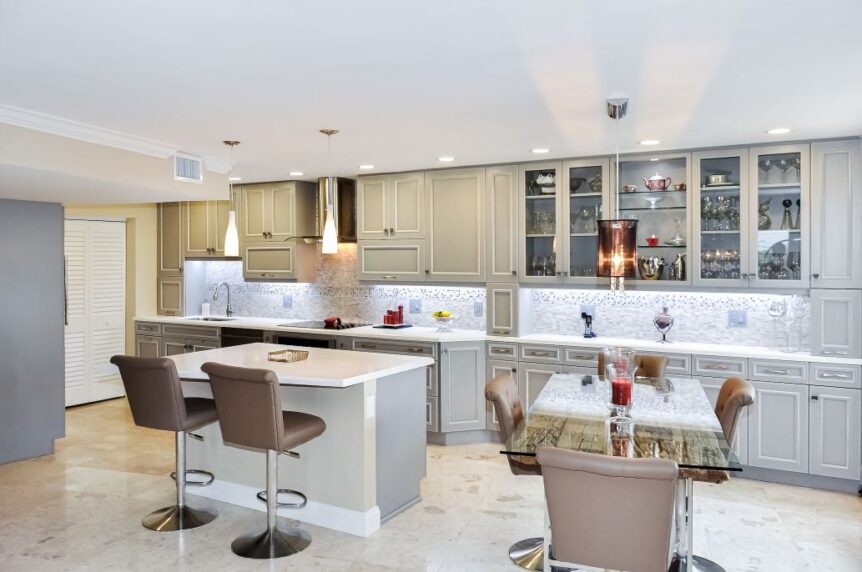
Taking out the wall between the kitchen and the living area to create an open concept kitchen is one of the most requested changes in older homes, and one of the easiest to get wrong. Below you’ll find the real trade-offs of a fully open kitchen versus a partly open one, what has to be checked before any wall comes down, and how to keep the new space from feeling like a noisy, smoky extension of the living room.
Open plan, broken plan and closed kitchens
A fully open kitchen shares one continuous space with the dining and living areas. Nothing separates them except furniture, an island or a change in flooring. A closed kitchen is its own room with a doorway.
Broken plan sits between the two. The rooms stay connected, but a half wall, a peninsula, a wide cased opening, a glass partition or a run of open shelving gives each area some definition. Plenty of homeowners who start out wanting everything open end up happier here, because it keeps the light and sightlines while hiding some of the mess.
| Closed | Broken plan | Fully open | |
|---|---|---|---|
| Daylight from other rooms | Limited | Good | Best |
| Talking with family or guests while cooking | Hard | Easy | Easiest |
| Cooking smells and noise | Contained | Partly contained | Spread through the space |
| Dirty dishes on view | Hidden | Partly visible | Fully visible |
| Wall space for cabinets | Most | Some | Least |
| Wall removal | None | Partial | Full |
What you gain by opening up
The case for an open kitchen is mostly about light and people. Many older kitchens sit in the middle of the house with one small window or none at all. Remove the wall and natural light from the living room windows reaches your counters.
- Connection. The cook can talk to guests, follow the game on TV or keep an eye on kids doing homework without shouting through a doorway.
- Room for an island or peninsula. The floor space a wall and doorway used to take up can become prep space, storage and seating. If that’s on your list, our guide to sizing and planning a kitchen island covers the clearances.
- Easier entertaining. Guests can gather and move around without crowding the person at the stove.
- A bigger-feeling home. Long sightlines make the whole floor feel larger, even though no square footage was added.

What you give up
The wall you remove was usually doing a job. It may have held wall cabinets, a pantry, the refrigerator or a row of outlets. With less wall, the storage has to go somewhere else: a taller run of cabinets on the remaining walls, a pull-out pantry, or deep drawers in the island.
- Noise travels. The hood fan, dishwasher and blender now share the room with the TV.
- Smells and grease travel too. Fried fish reaches the sofa cushions.
- Mess is always on display. Counters and the sink are visible from the living area, so clutter matters more.
- Cooling changes. In South Florida, air conditioning supply vents and returns laid out for two rooms may need adjusting once they serve one larger space.
None of these are reasons to rule out an open kitchen. They are reasons to plan for them up front, which the rest of this guide covers.
What to check before a wall comes out
You can’t tell what a wall is doing by looking at it. Before anything is demolished, it needs to be inspected from above, below and inside, so you know whether a full opening is realistic or a partial one makes more sense.
Structure
Walls that carry ceiling joists, roof framing or a floor above are load-bearing. Many can still come out, but the load has to transfer to a new beam and posts sized by a structural engineer. Sometimes that beam can hide inside the ceiling; other times it hangs below the ceiling line, and the design has to account for it. Some homes also have interior walls built from concrete block rather than wood studs, which changes the demolition work. Structural checks and the permit for this work are handled by your licensed contractor.
Plumbing, wiring and ductwork
Walls next to kitchens often hide drain lines, vent pipes, electrical circuits, light switches and air conditioning (HVAC) ducts. Wiring and switches are usually simple to move. Drains and vent pipes are harder, because drains need slope and vents have to continue up through the roof.
A duct can sometimes move into a soffit, which then becomes part of the design. If a vent pipe can’t be rerouted, a short wall stub or a column at the end of a peninsula is often the cleanest answer.
Permits and condo approval
Removing a wall, moving plumbing and adding circuits are permitted work, and a licensed remodeling contractor pulls the permits and coordinates inspections. If you live in a condo, your association may need to approve the work before it starts, and condo walls can carry shared pipes that serve other units. Ask for the building’s renovation rules early, before you fall for a plan.
Ventilation and noise in an open kitchen
With no wall to stop them, steam, grease and cooking smells drift straight into the living area. A range hood that vents to the outside handles this far better than a recirculating hood, which filters some grease but returns the air, and most of the odor, to the room. Venting steam out also helps in a humid climate.
- Size the hood to the cooktop. It should be at least as wide as the cooking surface. Over an island, go about 3″ wider on each side, since there are no walls to help funnel smoke upward.
- Think twice about an island cooktop. A wall hood captures smoke better than an island hood, and the duct route from an island is harder to hide. If the cooktop does go on the island, plan the duct path before the ceiling is closed up.
- Check noise ratings. Compare the sound level of hoods and dishwashers before you buy. A quiet dishwasher matters far more when it runs 15 feet from the sofa.
- Soften hard surfaces. Tile, stone and glass bounce sound around. Upholstered stools, a rug in the living area, curtains and soft-close drawers and doors all cut the clatter.
Defining zones without walls
An open kitchen still needs edges. Without them, the room reads as one big space with a kitchen parked in a corner.

- Use the island or peninsula as the boundary. Put the seating on the living side so guests face the cook, and keep at least 42″ of walkway between the island and the counters behind it.
- Light each zone on its own. Pendants over the island, recessed lights over the work areas and separate lighting in the dining and living areas, each on its own switch or dimmer, let you dim the kitchen while the living room stays bright.
- Decide how the floor will run. One continuous floor across kitchen, dining and living areas looks calm and avoids awkward transitions. Our guide to kitchen flooring that handles water and humidity covers materials that work across all three.
- Finish the side that faces the living room. The back of an island or the end of a cabinet run is now in full view, so give it finished panels, trim or open shelves rather than a plain side.
- Hide everyday clutter. A pull-out pantry, an appliance garage with a lift-up door and deep drawers with organizers keep counters clear when the whole room can see them.
- Use the ceiling. A soffit, a beam or a change in ceiling finish can quietly mark where the kitchen ends.
Choosing how open to go
Before settling on a fully open plan, answer a few honest questions. How often do you cook food with strong smells? Does someone usually watch TV or work in the living room while you cook? Can you live without the cabinets on the wall you’re removing? And what did the inspection find inside that wall?
If most answers point toward containment, a wide opening or a half wall with a counter on top gives you light and conversation without putting the whole kitchen on display. If they point toward openness, the next decision is the layout itself, and our overview of the main kitchen floor plans and how to pick one is a good place to start. For the other choices to settle before work begins, see our guide to planning a kitchen remodel.
Planning an open kitchen with Meltini
Meltini Kitchen and Bath Designs is a family-owned remodeler that has served South Florida since 2004. We start every project with design and detailed 3D renderings, so you can see the opened-up space from several angles and make revisions before a wall is touched. We hold a Florida Specialty Contractor License and a Broward County Contractor License, and a dedicated project manager stays your single point of contact from the first meeting to the final walkthrough. You can see more of our kitchen design and remodeling work or compare finishes in our Fort Lauderdale showroom.
Schedule a free consultation to talk through the wall you want gone and what’s behind it.

- Kitchen Floor Plans: How the Six Classic Layouts Work and How to Pick One - December 2, 2025
- Countertop Installation Details: Edges, Thickness, Seams and Overhangs - December 2, 2025
- Kitchen Flooring for a Humid Climate: Tile, Vinyl, Wood and Stone Compared - November 6, 2025