
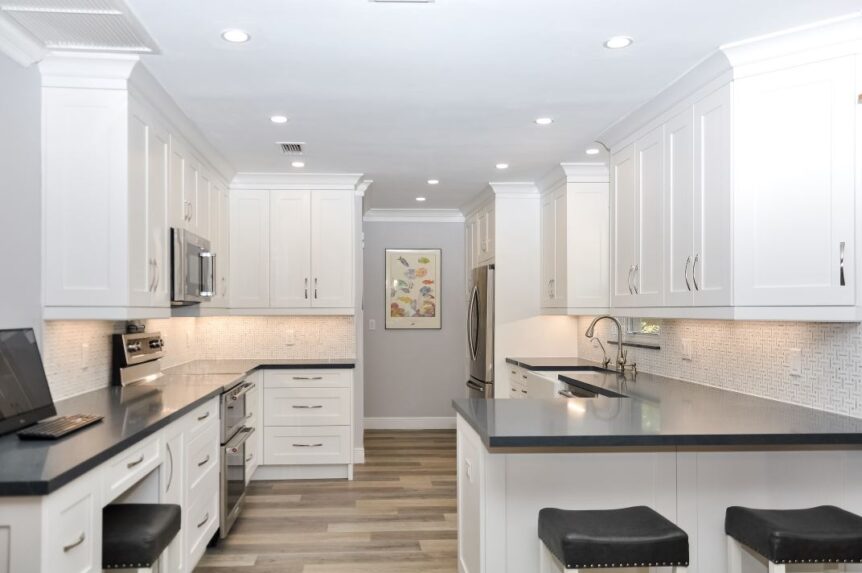
Most of what people call kitchen cabinet styles really comes down to the door. The door profile sets the tone of the room more than almost any other choice, and it also affects cleaning, hardware and how the kitchen wears over time. Here’s what each common door style looks like, what kind of kitchen it suits, and what to watch for.
Shaker doors
A Shaker door is a five-piece door: two vertical stiles and two horizontal rails form a frame around a flat, recessed center panel. The inside edge of the frame is square, with no decorative molding. That plain profile is why Shaker works in so many kitchens.

Color and hardware decide which way it leans. White Shaker with cup pulls reads traditional. The same door in a deep green with long bar pulls reads transitional. Slim Shaker, with rails noticeably narrower than the usual 2 to 3 inches, gives a more modern look while keeping the framed outline.
Two things to know. The recess along the bottom rail collects dust and crumbs, so it needs an occasional wipe. And on painted Shaker doors, a fine hairline can appear where the rails meet the stiles as the wood moves with humidity. That’s normal wood movement, not a defect, and an MDF center panel helps keep it to a minimum.
Slab and flat-panel doors
A slab door is a single flat piece with no frame and no recess. It’s the standard choice for modern and minimalist kitchens, and it’s often paired with frameless cabinet boxes so the fronts line up in a clean grid with narrow, even gaps.

The term “flat-panel” causes some confusion. Some people use it to mean slab, while others mean a Shaker-type door with a flat center panel. When you’re comparing quotes or samples, confirm which one is meant.
Slab doors come in painted MDF, wood veneer, laminate and thermofoil. Wood veneer slabs can be grain-matched so the pattern runs continuously across a whole wall of cabinets, which is one of the best-looking uses of the style. Slabs are the easiest doors to wipe down. The trade-off is that there’s no detail to hide anything: dents, chipped edges and, on high-gloss surfaces, fingerprints all show.
Inset doors
Most cabinet doors overlay the cabinet front, covering part or all of the face frame. Inset doors sit inside the frame instead, flush with it, with a thin, even gap around each door and drawer. The result looks like fine furniture and suits traditional and older homes especially well.
Inset is the most demanding door style to build. The gaps have to be consistent, often around ⅛ inch, and the doors must stay square so they don’t rub as the wood moves. You also lose a little interior space to the frame. Because of that precision, inset is mostly found in custom and higher-end semi-custom lines; this comparison of custom, semi-custom and stock cabinets explains why.
Raised panel and beadboard doors
Raised panel
On a raised panel door, the center panel is thicker in the middle and shaped with a beveled or profiled edge, so it stands out from the frame instead of sitting below it. The top rail can be square or arched. Raised panel is the most formal door style and fits traditional and Mediterranean-style interiors.

All that profiling means more edges to clean, and in a smaller kitchen a full run of raised panels can feel busy. Many people use it selectively, on an island or a hutch-style section, with simpler doors elsewhere.
Beadboard
Beadboard doors have a center panel made of narrow vertical boards separated by small grooves, set inside a frame. They give a cottage, coastal or farmhouse feel. The grooves catch grease, so beadboard works better on an island, a pantry or upper cabinets away from the cooktop than right beside the range.
Glass-front doors
A glass-front door is a frame, usually Shaker or slab-edged, with glass where the center panel would be. It lightens a long row of upper cabinets and gives you a place to show dishes or glassware.
- Clear glass shows everything, so it suits neat, matching contents.
- Frosted, reeded or seeded glass blurs what’s inside and is far more forgiving day to day.
- Mullions, the thin bars that divide the glass into panes, add a traditional touch.
- Interior lighting makes glass cabinets read well at night and is easiest to plan before the cabinets are built.
Glass works best on a few cabinets, not all of them, and away from the range where cooking residue films the glass. Use tempered glass for safety.
Handleless doors
Handleless cabinets are usually slab doors with no knobs or pulls on the face. You open them one of three ways:

- Integrated channels or finger pulls: a recessed rail runs along the top of each door or drawer, or a shallow lip is cut into the door edge, for your fingers.
- Edge pulls: a slim profile fixed to the top edge of the door, nearly invisible from the front.
- Push-to-open: a latch releases the door when you press it.
The look is clean and continuous, and nothing catches on clothing in a tight galley. Push-to-open does leave fingerprints where you press, and it suits light doors better than heavy pot drawers. For more on pulls, knobs, soft-close and push-to-open hardware, see this guide to choosing cabinets for the way you cook.
Matching a door style to your kitchen
| Door style | Look | Suits | Cleaning |
|---|---|---|---|
| Shaker | Framed, square-edged recessed panel | Almost any kitchen, depending on color and hardware | Easy; wipe the bottom rail |
| Slab | One flat surface | Modern and minimalist | Easiest; gloss shows prints |
| Inset | Flush inside the frame | Traditional, furniture-like kitchens | Easy; gaps collect a little dust |
| Raised panel | Shaped, raised center panel | Formal and traditional | More edges to wipe |
| Beadboard | Vertical grooved panel | Cottage, coastal, farmhouse | Grooves hold grease |
| Glass-front | Frame with glass insert | Accent uppers in any style | Glass needs regular cleaning |
| Handleless | Slab with no visible hardware | Contemporary, tight spaces | Easy; watch for fingerprints |
Start with the house itself. A door that echoes the trim, windows and architecture of the home looks settled; one that fights them looks dated sooner. Then be honest about how much detail you want to keep clean, especially with young kids or heavy daily cooking.
Mixing styles is common and works well when there’s a clear logic. Shaker on the perimeter with a slab island, or slab lowers with a few glass uppers, are both easy to pull off. Many kitchens also go two-tone and give the island its own color; this guide to kitchen island design covers how the island is planned. Keep the hardware finish consistent so the mix reads as intentional.
Climate matters too. In South Florida, humidity and constant air conditioning make solid wood expand and contract, which shows most on painted five-piece doors and on inset doors with tight gaps. Stable materials and a well-built frame help. The finish you choose also changes how a door handles moisture, sun and fingerprints, covered in this rundown of cabinet finishes.
Seeing door styles in person
Door styles are hard to judge from photos, because profile depth and gap size only show up in person. Meltini Kitchen and Bath Designs is a family-owned remodeling contractor that has served South Florida since 2004. At our Fort Lauderdale showroom you can compare door styles, wood species, finishes and hardware side by side, and every project starts with detailed 3D renderings so you can see your chosen doors from multiple angles and make revisions before anything is built. Learn more about our kitchen design and remodeling services.
Want to see these door styles side by side? Schedule a free consultation.

- Kitchen Floor Plans: How the Six Classic Layouts Work and How to Pick One - December 2, 2025
- Countertop Installation Details: Edges, Thickness, Seams and Overhangs - December 2, 2025
- Kitchen Flooring for a Humid Climate: Tile, Vinyl, Wood and Stone Compared - November 6, 2025